A powerful solar storm slammed into Earth on November 12, causing major disruptions to communication systems around the globe. The event, one of the most intense in the last twenty years, also triggered stunning aurora displays that were seen far beyond their usual polar regions. The British Geological Survey raised its forecast to the highest possible level, cautioning that this could be one of the largest storms observed in two decades.
The storm was classified as a G4, or severe, event on a global scale. In the United Kingdom, local activity reached G5, the maximum level on the geomagnetic storm scale. This produced the largest geoelectric field ever recorded in the UK since monitoring started in 2012. Forecasters at the National Oceanic and Atmospheric Administration issued warnings that the severe conditions could interfere with radio and GPS signals, impact power grids, and disrupt the operations of satellites in orbit.
A Triple Blast from the Sun
This powerful geomagnetic storm was the result of three separate coronal mass ejections, or CMEs, that erupted from a sunspot known as AR4274. These eruptions happened between November 9 and 11. The strongest of these events occurred on November 11, when an X5.1 class solar flare, the most powerful of 2025, reached its peak. This flare caused immediate radio blackouts across parts of Europe and Africa.
Scientists explained that the first two CMEs, which were traveling at different speeds, combined in space to form what is sometimes called a “cannibal storm.” This merged storm front reached Earth between November 11 and 12. The third and fastest CME, moving at an incredible speed of about 1,500 kilometers per second, arrived on November 12. According to the European Space Agency, having multiple CMEs hit Earth in quick succession made the overall storm much more severe.
Spectacular Aurora Displays Seen Across the Globe
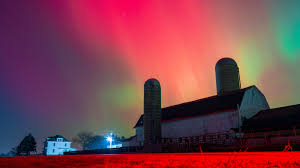
One of the most visible effects of the geomagnetic storm was the creation of spectacular auroras, also known as the northern lights. These colorful light displays were seen far outside of their typical polar locations. In the United States, sightings were reported across most of the northern states. Amazingly, the lights were also visible as far south as Alabama, Northern California, Florida, and Texas. The beautiful phenomenon was seen across the entire Northern Hemisphere, with reports coming in from coast to coast in North America and all throughout Europe.
The sun is currently at the peak of its 11 year activity cycle, which is known as the solar maximum. During this phase, intense solar events like this one become much more common. Space weather experts predict that this period of high solar activity will likely continue through the end of 2025. However, the exact peak of the cycle can only be confirmed several months after it has passed. The last time a geomagnetic storm of this strength occurred was in May 2024, when a G5 level event also brought the northern lights to unusual locations and caused some navigation systems to fail.