Top diplomats from the world’s leading democratic nations met in Canada’s Niagara region on Tuesday, facing major disagreements over President Donald Trump’s trade policies and defense spending requirements. These issues have created deep fractures within traditional alliances.
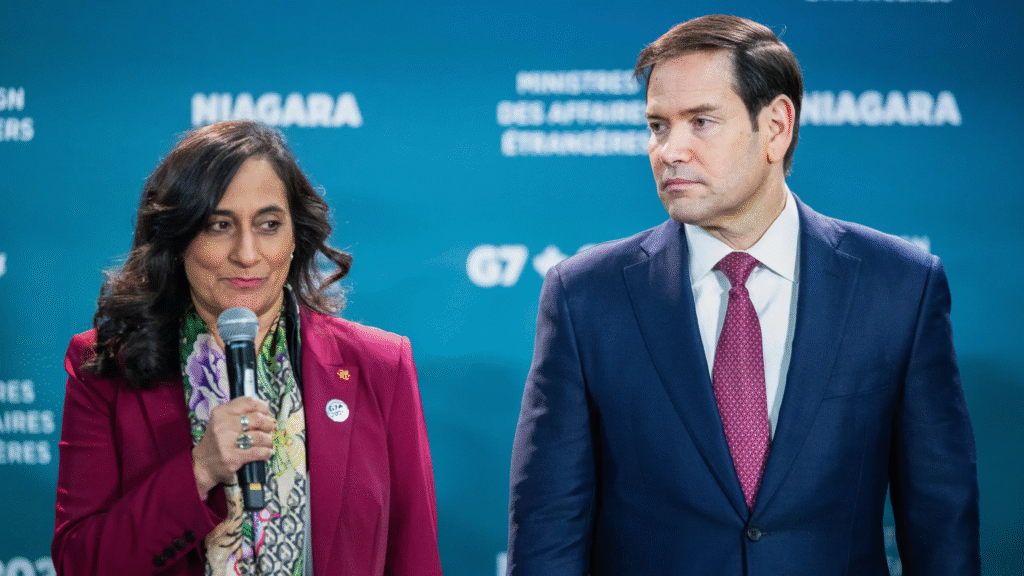
Canadian Foreign Minister Anita Anand hosted the two day summit, welcoming U.S. Secretary of State Marco Rubio and officials from Britain, France, Germany, Italy, and Japan. Representatives from several other countries, including Australia, India, South Korea, and Ukraine, were also in attendance. The meeting began at a time of high tension between Washington and its closest partners, with Trump’s threats of tariffs and ultimatums about NATO spending taking center stage.
U.S. Secretary of State Rubio stated on social media that the main focus was on putting the safety and security of Americans first. The summit started just days after President Trump halted trade talks with Canada. This followed a provincial advertisement in Ontario that criticized his tariffs, highlighting the strained relationship between the two neighboring countries.
Defense Spending Creates Major Disagreement
The summit quickly revealed sharp divisions over President Trump’s demand that all NATO members increase their defense spending to 5% of their gross domestic product by the year 2035. This is more than double the alliance’s previous target of 2%. With the exception of Japan, all G7 nations are members of NATO, and this new benchmark has caused significant friction. Among the G7 members, Canada and Italy are currently the furthest from reaching this goal.
In response, Canadian Foreign Minister Anand announced that her country would meet the new target. She told reporters that Canada’s recent budget includes 80 billion Canadian dollars for defense spending and that the country will reach the 2 percent goal this year and the 5 percent goal by 2035.
This debate over defense spending highlights broader tensions within the NATO alliance. While some countries like Estonia, Lithuania, and Latvia have promised to meet the 5% target by next year, major Western European powers such as France and the United Kingdom face political challenges to increasing their spending so quickly.
Support for Ukraine Remains a Key Focus
The foreign ministers also planned to meet with Ukrainian Foreign Minister Andriy Sybiha on Wednesday. The goal of the meeting was to reaffirm their support for Ukraine as Russia continues its attacks on civilian infrastructure. Ahead of the meeting, Britain announced £13 million in new aid to help repair Ukraine’s energy grid before winter. UK Foreign Secretary Yvette Cooper warned that Russian President Vladimir Putin is attempting to plunge Ukraine into darkness and cold as winter approaches.
This funding will go towards repairing power, heating, and water systems that have been damaged by Russian attacks. Canada recently made a similar promise, speeding up the final payment of its 70 million Canadian dollar contribution to the Ukraine Energy Support Fund.
However, there are still disagreements on how to end the war. Most G7 members have taken a stronger stance against Russia than President Trump, who has suggested that Ukrainian President Volodymyr Zelenskyy should consider giving up territory to Moscow.
Gaza and Other Global Tensions on the Agenda
The situation in Gaza was also a topic of discussion. Secretary Rubio had previously asked Minister Anand to help organize a future conference on the reconstruction of Gaza, as part of an effort to support Trump’s ceasefire plan. Anand stated that she and Rubio agree that the president’s work to end the war is crucial and that Hamas must be disarmed and have no future role in governing Palestinians. The G7 has also seen internal divisions on the Israeli-Palestinian conflict, with Britain, Canada, and France recently announcing their intention to recognize a Palestinian state.
Other topics on the summit’s agenda included security in the Arctic, critical minerals, maritime safety, and the ongoing crises in Haiti and Sudan. As the host of the G7 presidency this year, Canada invited several non-member countries to address what Anand called challenges that go beyond the G7 and its borders.